
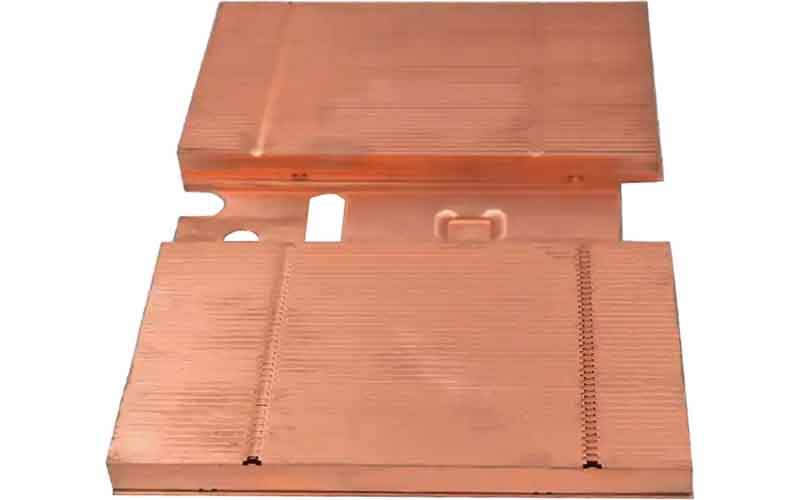
Pure copper Clip-fin Stamped Heat Sink
Application scenarios:
laser projectors, photovoltaic inverters, high-power LED lamps, rectifier modules, variable frequency drives (VFDs), inverters, arc welding, motors, switching power supplies, uninterruptible power supplies (UPS), home 3D printers, laser diodes (LD), light-emitting diodes (LED), vertical-cavity surface-emitting lasers (VCSEL), laser drivers / LED drivers, electro-optic modulators (such as LiNbO₃ modulators and silicon photonic modulators), thermoelectric coolers (TEC), microcontrollers / temperature control ICs / power management chips, power amplifiers (PA) / transimpedance amplifiers (TIA), optical transceivers (such as SFP+/QSFP+/OSFP), and silicon photonic chips.
This is a copper heat sink assembly, designed for thermal management in electronic devices. It offers the following advantages:
• Excellent Thermal Conductivity: Copper has a high thermal conductivity, enabling rapid absorption and transfer of heat across the fins. Compared to aluminum heat sinks, it offers significantly improved heat dissipation efficiency, making it ideal for compact spaces and high heat flux scenarios.
• Flexible Structural Adaptability: Through processes such as stamping and cutting, copper fins can be manufactured in various shapes and sizes to precisely match the confined spaces and thermal layouts of different devices, allowing easy integration into compact thermal modules.
• Lightweight Advantage: Compared to bulky cooling solutions (such as certain liquid cooling components), copper fin assemblies are relatively lightweight. This makes them well-suited for consumer electronics and portable devices where weight is a critical design factor.
• Cost-Effective: With mature mass production techniques and relatively low manufacturing complexity, copper fins offer efficient heat dissipation while keeping material and processing costs under control. They are ideal for large-scale applications in consumer electronics and small devices.
• High Stability: Copper has good chemical stability and resists oxidation and deformation over time. This ensures consistent cooling performance and reduces the need for maintenance during long-term operation.